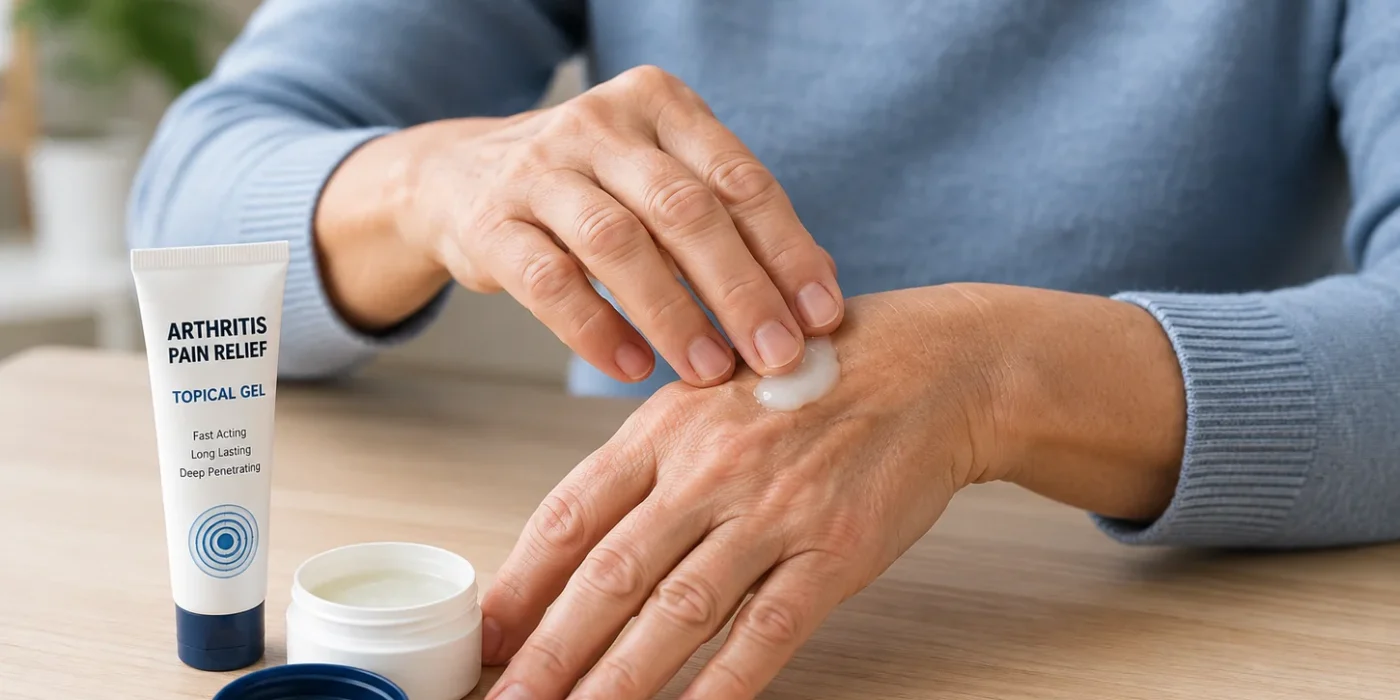
There’s a tube in almost every bathroom cabinet in Australia. A gel, a cream, maybe a roll-on. You reach for it on the mornings when your hands feel like they belong to someone else, or before a day you know will involve too much standing. You rub it in, you wait, and somewhere in the back of your mind there’s a question you’ve never quite answered: is this actually doing anything?
It’s a fair question. Your knee joint sits underneath skin, fat, muscle and connective tissue. Your hip sits deeper still. Asking a cream to travel that far and change something meaningful sounds, on the face of it, optimistic.
The honest answer is that topical treatments do work — but modestly, unevenly, and far better for some joints than others. Understanding where they genuinely help, and where you’re better off putting your energy elsewhere, makes the difference between a tube that earns its place and one that quietly disappoints you for months.
What Counts as a Topical Treatment?
“Topical” simply means applied to the skin rather than swallowed. It’s a broad category, and the differences between formats matter more than most people realise.
Creams, gels and ointments are the most familiar. Gels tend to absorb quickly and dry off, which suits joints you need to use straight away — hands, wrists, elbows. Ointments sit on the skin longer and feel greasier, which some people prefer overnight. Creams sit somewhere in between.
Patches and plasters deliver their ingredients steadily over several hours from one fixed spot. They suit a knee or a lower back where you want continuous coverage without reapplying, and they’re useful if you’re likely to forget the third application of the day.
Sprays and roll-ons solve a practical problem rather than a chemical one. If your grip is unreliable or your fingers are the sore part — familiar territory for anyone also managing carpal tunnel — squeezing a tube and rubbing with the other hand is genuinely difficult. A roll-on removes that step.
Balms, liniments and herbal compresses belong to a much older category. Across Thai, Chinese and broader Asian herbal traditions, warmed plant preparations have been pressed and rubbed into aching joints for many generations. These are prepared differently and used differently from anything you’d buy at a pharmacy counter, and we’ll come back to them.
How Topical Treatments Actually Work
Your skin is not a sponge. Its outermost layer exists specifically to keep things out, and it’s very good at the job. Whether a substance crosses it depends on the size of the molecule and how comfortably it mixes with the natural oils in your skin.
This is why the formulation matters as much as the ingredient. The same active compound in a different base can perform quite differently, which is part of why two products with near-identical labels can give you noticeably different results.
Local concentration is the whole point
When a topical works, it works by building up in the tissue directly beneath where you applied it, rather than travelling around your whole body. Studies measuring topical anti-inflammatory gels have found that the amount reaching the bloodstream is a small fraction — somewhere in the range of half a percent to a couple of percent — of what an equivalent tablet produces.
That single fact explains most of the appeal. You get useful concentration where the ache is, without the same systemic load on your stomach and kidneys that comes with taking tablets every day for years.
Depth changes everything
Here’s the part most articles skip, and it’s the most useful thing on this page.
Your knuckles, fingers, wrists and the front of your knee sit close to the surface. There isn’t much between the skin and the joint capsule. Your hip, by contrast, is buried under some of the thickest muscle in your body, and if you’re dealing with arthritis in the back, the joints involved sit deeper still.
A topical treatment does not choose where to go. It goes where the physics takes it. This is why the same gel that makes a real difference to your hands may do very little for your hip — not because the product is poor, but because the distance is too great. If you’ve ever wondered why a treatment that helped one joint seemed useless on another, this is usually the answer.
What the Evidence Actually Shows
Topical treatments provide real but incremental relief. The strongest evidence supports anti-inflammatory gels for hand and knee osteoarthritis, where they perform comparably to tablets with a considerably gentler effect on the rest of the body. Evidence for other topical categories is thinner, though not absent.
Here’s how the main groups compare.
Anti-inflammatory gels
These are by far the best studied. Cochrane reviews looking at hand and knee osteoarthritis found that topical diclofenac and topical ketoprofen cut pain by at least half over six to twelve weeks in roughly one in five to one in ten people.
Read carefully, those numbers are both encouraging and sobering. Around six people in ten improved meaningfully on the active gel — but around five in ten improved on the inactive gel used for comparison. The treatment is doing something real. It is not doing everything.
Counterirritants
Menthol, camphor and methyl salicylate work differently. Rather than reducing inflammation, they create a cooling or warming sensation that competes with pain signals for your nervous system’s attention. The effect arrives within minutes and feels wonderful.
It’s also short-lived, and the evidence behind it is much weaker than for anti-inflammatory gels. That doesn’t make these products worthless — a genuine hour of comfort is worth having — but it does mean you should judge them on immediate relief rather than expecting them to change anything over months.
Capsaicin
Derived from chilli, capsaicin works by gradually depleting a pain-signalling compound in the nerve endings near the surface. This takes weeks of consistent daily use before any benefit appears, and the early applications often burn.
Most people who try capsaicin stop before it has had a chance to work. If you’re going to use it, commit to it properly or don’t start.
The part nobody mentions
Response rates to the inactive comparison gel in these trials are substantially higher than response rates to a placebo tablet. Sitting down, taking a few minutes for yourself, and massaging something cool into a sore joint appears to do something on its own.
This isn’t a reason to be cynical about topicals. It’s a reason to understand what you’re paying for, and to recognise that the ritual around the treatment may be contributing as much as the tube.
Topical compared with tablets
Trials that put the two head to head found that around 55% of people got meaningful relief from a topical anti-inflammatory, compared with around 54% from an oral one. Broadly comparable relief, with a meaningfully different safety profile.
That comparison is worth carrying with you into a conversation with your GP, particularly if you’ve been on daily tablets for a long time.
Where Topicals Work Best — and Where They Fall Short
| Situation | How well topicals suit it |
| Hands, fingers, wrists, elbows | Very well — the joint is close to the surface |
| Knees, ankles, feet | Generally well, especially the front of the knee |
| Hips, shoulders, lower spine | Poorly — too much tissue in the way |
| One or two sore joints | Ideal; this is what topicals are built for |
| Many joints at once | Impractical, and the total dose adds up quickly |
| Sudden flare-up | Fast-acting counterirritants can help immediately |
| Ongoing daily management | Anti-inflammatory gels, used consistently for weeks |
The pattern is straightforward once you see it. Topicals suit a localised problem in a shallow joint. The further your situation drifts from that description, the less you should expect. Which type of arthritis you’re dealing with matters here too — conditions that involve many joints at once are a poor match for an approach built around treating one spot.
If you’re applying gel to six different joints twice a day, you’ve outgrown what topicals are designed to do — and you may be absorbing more than you think, since small amounts from many sites still add up.
Getting More Out of a Topical Treatment
Most people who feel let down by a topical are using it in ways that quietly undercut it. A few adjustments are worth making before you conclude the product doesn’t work.
Use enough. Underdosing is the single most common mistake. Follow the measurement on the packaging rather than guessing, and cover the whole joint rather than the spot that hurts most — the sore point is rarely the whole story.
Be consistent. Anti-inflammatory gels are usually applied several times a day, and the trials showing benefit ran for six to twelve weeks. A tube used twice in a fortnight, on your worst days only, was never going to demonstrate much.
Warm the joint first. A shower or a heat pack before application makes the whole process more comfortable and helps you move the joint gently afterwards, which matters more than the gel does — though it’s worth knowing which movements to avoid so you’re not undoing the benefit an hour later.
Give it time before judging. Counterirritants tell you within minutes. Anti-inflammatory gels need a few weeks. Capsaicin needs longer still. Set the right expectation for the right product and you’ll make better decisions about what to keep.
Wash your hands afterwards — properly, every time. Rubbing your eyes after applying capsaicin is an experience you only need once.
Watch your skin. Irritation where you apply is the most common problem, and it’s more frequent with active gels than with inactive ones. Mild redness often settles. Anything persistent, blistering or spreading means stop and check in with your pharmacist.
Don’t stack products. Using two topicals plus daily tablets is easy to drift into and harder on your body than any single one of them. Keep a simple list of what you’re actually using.
Topical Traditions in Asian Herbal Medicine
Long before anyone measured absorption rates, people were pressing warmed herbs into sore joints.
In Thai herbal tradition, the herbal compress is a well-established practice — aromatic plant material bundled in cloth, steamed until hot, and pressed against the body. The warmth opens things up; the plants have their own long history of traditional use for stiffness and aching. Chinese herbal medicine developed its own liniments and plasters over a comparable stretch of time, and similar approaches turn up across the region.
These never stood alone. Cupping and acupuncture both work on the body from the outside in their own ways, and both come from the same traditions that produced the balms. Nobody was expected to choose one.
What’s interesting about these traditions isn’t just the preparations themselves. It’s how they were positioned.
In almost every case, the topical application was one part of something larger. It sat alongside preparations taken internally, alongside movement, alongside attention to rest and to what you eat. Nobody in these traditions treated a balm as the entire answer. It was understood as working on the surface, on one place, while something else worked more broadly.
That’s a genuinely useful perspective to bring to a modern bathroom cabinet — and it happens to line up with what the research shows. A topical is good at one job in one location. It was never meant to carry everything.
Safety, Interactions and Your GP
A few things worth keeping straight:
- Topical anti-inflammatories still enter your bloodstream in small amounts. If you have kidney concerns, a history of stomach ulcers, or you take blood thinners, mention your gel to your GP — people often don’t, because it doesn’t feel like real medication.
- Never apply to broken, irritated or infected skin, and don’t cover a treated area with a tight bandage unless you’ve been told to.
- Herbal preparations, taken internally or applied to the skin, can interact with prescription medicines. Tell your GP and pharmacist everything you’re using, including things you’d think of as natural.
- A joint that is newly swollen, hot, red, or getting worse despite treatment deserves proper assessment rather than another tube.
None of the above is a substitute for advice tailored to you. It’s a starting point for a better conversation with someone who knows your history.
Frequently Asked Questions
Do arthritis creams actually work, or is it just the massage? Both are contributing. Anti-inflammatory gels show a genuine effect over and above the inactive comparison in clinical trials, but the response to the inactive gel is also high. The massage and the ritual are doing real work alongside the ingredients.
How long before a topical starts helping? Counterirritants like menthol work within minutes but fade quickly. Anti-inflammatory gels need consistent use over several weeks before you can judge them. Capsaicin needs the longest run-in of all, often a few weeks of daily use.
Can I use an arthritis gel every day, long term? Many people do, but check with your pharmacist or GP first, particularly if you have kidney or stomach concerns or take other medications. Follow the maximum daily amount on the packaging rather than applying by feel.
Is a topical safer than taking tablets? Generally it puts less load on your system, because far less reaches your bloodstream. That’s a real advantage, not a guarantee of safety — the main trade-off is skin irritation where you apply it.
Can I use a topical and tablets at the same time? Sometimes, but not without asking. Combining them raises your total dose in ways that aren’t obvious. This is a specific question for your GP or pharmacist.
Why does my gel help my knee but do nothing for my hip? Depth. Your knee sits close to the surface; your hip is buried under thick muscle. The product hasn’t failed — it simply can’t travel that far in useful quantities.
The Short Answer
Topical treatments are worth using, within limits. For hands, knees and other joints near the surface, anti-inflammatory gels offer relief that stands up in clinical trials and is gentler on the rest of your body than daily tablets. For deep joints, or when many joints are involved at once, expect considerably less. Use enough, use it consistently, and give the right product the right amount of time before you decide.
And keep the older perspective in mind. Every tradition that used topical preparations treated them as one part of a broader approach rather than the whole of it. Thai and Chinese herbal practice both took that view — something working on the surface, while other things worked more widely.
Natural Support Alongside What You’re Already Using
Living with sore joints doesn’t mean accepting constant discomfort or limited movement. Understanding how topicals actually work, using them properly, staying active within your abilities, and drawing on both conventional and traditional approaches all add up to something better than guesswork.
At Authentic Arthritis Asian Herbs, we’re passionate about bringing the wisdom of traditional Asian herbal medicine to Australians looking for natural support in mild arthritis. Ours is a Thai herbal preparation taken as directed rather than rubbed in — the internal half of an approach the old traditions never split apart, and a companion to a topical rather than a replacement for one. The herbs in it carry a long history of traditional use for joint comfort and mobility, which is a different kind of story from the clinical trials earlier on this page, and we’d rather say so plainly than blur the two.
Whether your joints have only recently started bothering you or you’ve been managing them for years, we’d be glad to help you work out where traditional herbal support might fit. Visit our online store to learn more about our formulation, or read about the individual herbs and their traditional uses in our herb guides. Your comfort starts with understanding your options — and we’re here to help you every step of the way.
If you’re currently using a topical treatment or taking prescribed medication, speak with your GP or pharmacist before adding a herbal preparation.
ALWAYS READ THE LABEL AND FOLLOW THE DIRECTIONS FOR USE.