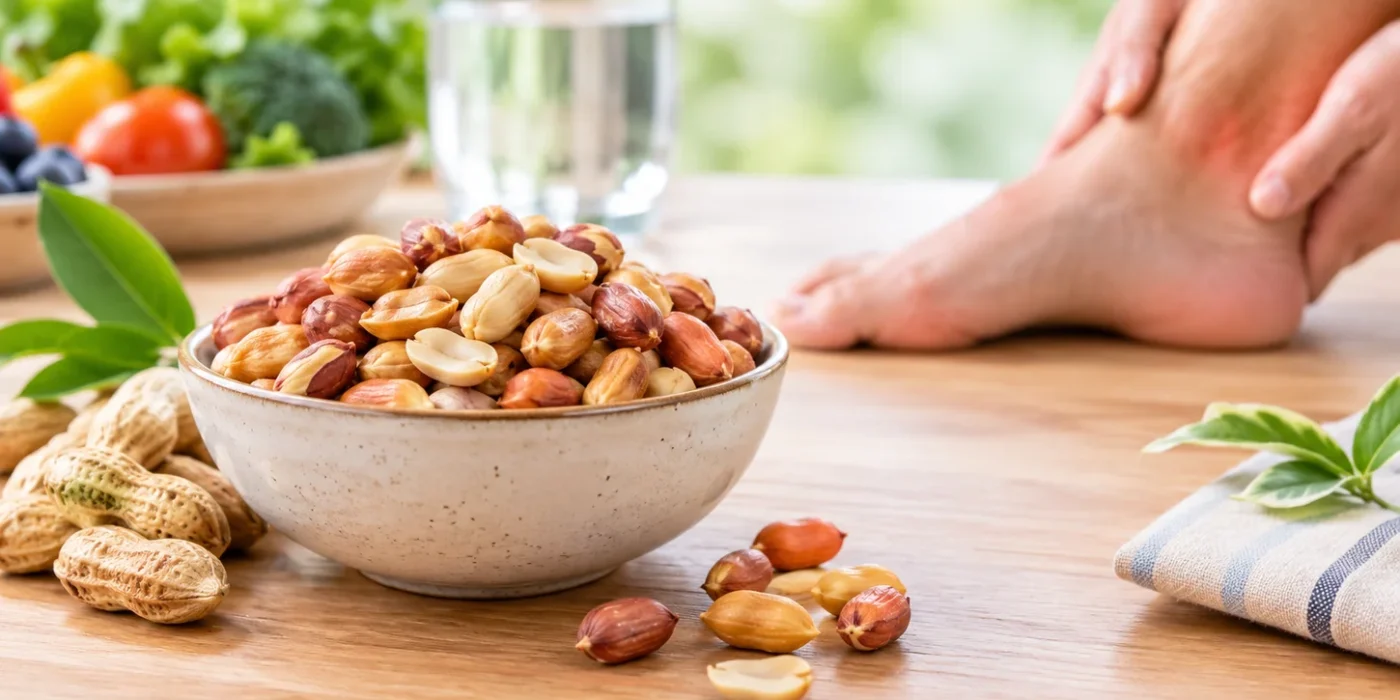
If you have gout and you enjoy peanuts, you have probably wondered whether they belong on your plate or not. The short answer is that peanuts are not generally considered a food that people with gout need to completely eliminate simply because they contain purines. That distinction matters because a lot of well-meaning dietary advice bundles all purine-containing foods together — and that is not how gout management actually works.
Gout is a form of inflammatory arthritis driven by elevated uric acid levels in the blood. When uric acid builds up beyond what the body can clear, it can crystallise and deposit in and around joints, triggering the intense pain and swelling associated with a gout flare. Dietary purines — the compounds that break down into uric acid — are one contributing factor, but they are far from the whole story.
This article covers:
-
How peanuts relate to purines
-
Whether peanuts raise uric acid levels
-
Whether peanuts can trigger a gout attack
-
Which peanut products may be less suitable
-
How peanuts compare with other common foods
-
How to approach diet when living with gout
So, Are Peanuts Bad for Gout?
No — not in any straightforward sense. For most people with gout, peanuts do not need to be automatically eliminated from the diet. The picture is more nuanced than that, and understanding why will help you make better food decisions overall.
Peanuts Are Not Automatically a Problem Because They Contain Purines
The presence of purines in a food does not automatically mean that food will worsen gout. There is an important difference between:
-
A food that contains purines
-
A food that significantly raises uric acid
-
A food that is genuinely associated with gout attacks
These are three separate questions, and peanuts do not clearly sit in the second or third category based on available evidence. People searching for “are peanuts bad for gout?” often assume that any purine-containing food must be cut out entirely — but that assumption is too broad and not well supported by the research.
Peanuts contain a modest amount of purines. They are not classified among the high-purine foods most consistently associated with elevated uric acid or gout attacks, particularly when you compare them with animal-derived foods such as organ meats, red meat and certain seafood.
Peanuts Can Fit Into a Balanced Gout-Friendly Diet
Rather than labelling peanuts as either “safe” or “dangerous,” it is more useful to think about reasonable portions and overall dietary patterns. A small handful of plain peanuts alongside a well-balanced meal is a different dietary situation from regularly consuming large quantities of heavily processed, sugar-laden peanut snacks.
Peanuts should not be positioned as a treatment for gout or as something that will directly lower uric acid. That would overclaim the evidence. What the research does suggest is that, in the context of a varied diet, plain peanuts are unlikely to be a meaningful driver of elevated uric acid in most people.
Your Overall Diet Matters More Than One Food
Gout management should not revolve around obsessively eliminating individual foods while ignoring broader lifestyle patterns. Factors that have a more consistent and stronger relationship with gout risk include:
-
Overall dietary pattern — a diet high in red meat, organ meats and alcohol carries more gout risk than a diet that includes occasional peanuts
-
Alcohol intake — particularly beer and spirits
-
Sugary drinks and high-fructose beverages — fructose raises uric acid through a metabolic pathway separate from dietary purines
-
Meat and seafood intake — especially organ meats and certain seafood varieties
-
Hydration — inadequate fluid intake is commonly cited in gout self-management guidance
-
Body weight and metabolic health — excess weight is associated with higher uric acid levels
-
Individual triggers — some people notice personal patterns that differ from population-level trends
As the Mayo Clinic notes, dietary changes can help with gout management but are not a cure and will often need to be combined with appropriate medical management.
Are Peanuts High in Purines?
What Are Purines?
Purines are naturally occurring compounds found throughout the body and in many everyday foods. They play important roles in cellular function, including in DNA structure and energy metabolism. When the body breaks down purines — whether produced internally or taken in through food — uric acid is the end product.
Why Do Purines Matter for Gout?
The connection between purines and gout follows a straightforward pathway:
Importantly, the body itself produces a substantial amount of uric acid through its own cellular processes, independent of diet. Evidence reviewed by the National Center for Biotechnology Information (NCBI) notes that dietary changes can only account for a portion of circulating uric acid, because much of it originates within the body rather than from food. This is a key reason why diet alone can never fully explain or control gout in most people.
Does Purine Content Automatically Make a Food Bad for Gout?
No. This is one of the most common misconceptions around gout and diet. The source of dietary purines matters considerably. Plant-based purine-containing foods — including peanuts, lentils, spinach and mushrooms — have not been shown to carry the same relationship with gout attacks as certain animal-derived high-purine foods. Research has consistently found that vegetable sources of purines are handled differently by the body and are less reliably associated with elevated serum urate or acute gout attacks.
So if you have been told to avoid all purine-containing foods, it is worth revisiting that advice with a healthcare professional, because the evidence does not support such a blanket approach.
Do Peanuts Increase Uric Acid?
What the Research Says About Peanuts and Uric Acid
The available evidence does not support treating peanuts as a food that raises uric acid. A large diet-wide analysis found that peanut intake was associated with lower serum urate in some populations, although the association did not remain consistently significant after every dietary adjustment. Importantly, the same researchers noted that individual dietary factors explained only a small portion of the variation in serum urate compared with genetic factors — meaning your genes have considerably more influence over your uric acid levels than whether or not you eat peanuts.
This provides a useful evidence-based counterpoint to the assumption that peanuts necessarily raise uric acid. The evidence, imperfect as it is, tilts in the opposite direction of common concern.
Peanuts Are Different From High-Purine Animal Foods
The broader evidence around gout consistently places greater concern on certain animal-derived foods — particularly red meat, organ meats and specific varieties of seafood — rather than treating every purine-containing food identically. Peanuts, as a plant food, sit in a meaningfully different category from those established dietary concerns. Equating peanuts with liver or anchovies when it comes to gout risk is not supported by the evidence.
Individual Responses Can Still Vary
This article is not suggesting that peanuts are universally harmless for every person with gout. Individual responses to food can and do vary. Some people notice that particular foods coincide with symptoms, even when those foods are not among the most well-established triggers. Keeping a food and symptom diary over several weeks can help identify personal patterns that may not apply to the broader population — and those findings are worth discussing with your doctor or dietitian.
Can Peanuts Trigger a Gout Attack?
There Is No Good Reason to Treat Peanuts as a Universal Gout Trigger
Based on available evidence, peanuts should not automatically be placed in the same category as recognised dietary gout triggers. They are not among the foods most consistently implicated in gout attacks across research studies or clinical guidance. Treating peanuts as a gout trigger without personal evidence to support that conclusion is likely to result in an unnecessarily restrictive diet without a meaningful benefit.
What Actually Makes a Gout Flare More Likely?
Better-established dietary contributors to gout flares include:
-
Organ meats — liver, kidney, sweetbreads and similar cuts are among the highest-purine foods available
-
Certain seafood — anchovies, sardines, herring, mussels, scallops and trout in particular
-
Large amounts of red meat — beef, lamb and pork consumed in significant quantities
-
Alcohol — beer and spirits raise uric acid through multiple pathways and are among the most reliably established gout triggers
-
Sugary drinks and high-fructose beverages — fructose is metabolised in a way that directly increases uric acid production
-
Very large meals overall — significant caloric excess can contribute to metabolic conditions associated with elevated uric acid
For a more detailed overview, see this article covering the foods that trigger gout.
Don’t Blame Every Gout Flare on the Last Food You Ate
This is a useful point for anyone prone to second-guessing their meals after a flare. Gout attacks develop over time, driven by the gradual accumulation of urate crystals in joints, not simply by what you ate in the hours before the pain started. A flare occurring after a particular meal does not necessarily mean that meal caused it. Assuming a direct cause-and-effect relationship between the last thing you ate and an acute gout attack can lead to unnecessary dietary restrictions and anxiety, without addressing the actual drivers of the condition.
Are All Peanut Products Suitable for People With Gout?
Peanuts in their various forms are not nutritionally equivalent, and this distinction matters for anyone trying to eat well while managing gout.
Plain Peanuts
Unsalted, minimally processed peanuts are the simplest option and the form most likely to fit within a balanced diet. They provide protein, healthy fats, fibre and micronutrients without the additions that make other peanut products less straightforward.
Salted Peanuts
Salt itself is not what makes a food problematic for gout, but heavily salted snack foods can contribute to excessive sodium intake and may not align with broader health goals. For most people, lightly salted peanuts in reasonable portions are unlikely to be an issue, but heavily salted commercial snack packs consumed in large quantities are a different matter.
Roasted Peanuts
Roasting does not transform peanuts into a gout-triggering food. Dry-roasted peanuts without significant added ingredients remain comparable to raw peanuts from a gout-management perspective. Be mindful of roasted peanut products that include large amounts of added oil, salt or flavourings.
Peanut Butter
Peanut butter is a popular way to consume peanuts, but the quality and composition of commercial peanut butter products vary considerably. When choosing peanut butter, look at the ingredient list for:
-
Added sugar — some commercial peanut butters contain significant amounts
-
Excessive salt — unnecessary in a product that does not need it for palatability
-
Portion size — peanut butter is calorie-dense and easy to overconsume
-
Added oils — palm oil and other additions are common in processed varieties
A natural peanut butter made from peanuts alone, or with minimal additions, is the most straightforward option.
Sweetened Peanut Snacks and Desserts
This is where the category of “peanut products” diverges meaningfully from plain peanuts. Products such as peanut brittle, chocolate-coated peanuts, peanut-flavoured confectionery and sugary peanut snack bars contain:
-
Added sugars and syrups
-
Chocolate and confectionery ingredients
-
High fructose corn syrup in some imported products
-
Significant caloric density beyond the peanuts themselves
The concern with these products is not primarily the peanuts — it is the sugar and fructose content. High-fructose foods raise uric acid through a metabolic pathway that operates independently of dietary purines, and sugary snacks have a stronger evidence base as gout contributors than peanuts themselves.
How Many Peanuts Can You Eat If You Have Gout?
There is no universally agreed precise daily limit for peanut consumption in gout management, and any article claiming to give you a medically rigid “safe number” would be overclaiming the evidence. What is reasonable instead:
Think About Portion Size
Even foods that fit well within a balanced diet can contribute excess calories in very large quantities. A small handful — roughly 30 grams — is a commonly used reference portion for nuts and is unlikely to contribute meaningfully to uric acid levels for most people. Regularly consuming much larger amounts of any calorie-dense food contributes to weight gain, and elevated body weight is independently associated with higher uric acid levels.
Consider the Rest of Your Diet
Context matters. A handful of plain peanuts alongside a vegetable-rich meal that is moderate in meat and free of alcohol is nutritionally different from peanuts consumed alongside large amounts of red meat, processed food and soft drinks. Gout-related dietary advice always needs to be considered in the context of the whole eating pattern.
Pay Attention to Your Own Response
If you repeatedly notice a pattern between eating peanuts and experiencing joint symptoms, that observation is worth taking seriously. Discuss it with your healthcare professional rather than either ignoring it or making sweeping dietary changes based on an assumption. A brief food and symptom diary can help you provide your doctor or dietitian with useful information.
Are Nuts Bad for Gout?
Peanuts Are Not the Only Nut People Ask About
Questions about nuts and gout extend well beyond peanuts. People with gout commonly ask about:
-
Almonds — popular as a snack and widely regarded as nutritionally dense
-
Walnuts — often discussed in the context of anti-inflammatory eating patterns
-
Cashews — creamy texture and relatively low purine content
-
Pistachios — consumed frequently as a snack and in cooking
-
Brazil nuts — known for selenium content; consumed in smaller quantities
-
Macadamias — a popular Australian snack nut, higher in fat but not in purines
Don’t Assume Every Nut Has the Same Effect
Nutritional composition varies between different varieties of nuts. Purine content, fat type, fibre, and other nutritional factors differ. The simple statement that “nuts contain purines” is not a sufficient basis for concluding that a food is inappropriate for someone with gout. Nuts as a food group are not among the dietary categories most strongly associated with gout attacks.
Choosing Nuts as a Snack
Practical guidance for nut selection in the context of gout management:
-
Choose plain or lightly processed options where possible
-
Prefer unsalted varieties if you are managing overall sodium intake
-
Avoid products with added sugar or sweetened coatings
-
Keep portions reasonable — a small handful is a practical reference
What Should You Eat If You Have Gout?
Build Meals Around a Balanced Diet
The evidence for gout management consistently supports looking at the overall eating pattern rather than fixating on individual purine numbers. A diet rich in vegetables, whole grains, legumes and adequate protein from varied sources is a more useful framework than a list of individually prohibited foods.
Include a Variety of Plant Foods
Vegetables, fruits and other plant foods should feature prominently in a gout-friendly diet. NCBI-reviewed evidence notes that several purine-rich plant foods — including lentils, mushrooms and spinach — have shown little to no meaningful increase in gout attack risk compared with the assumptions often made about purines generally. This supports the view that plant-based eating patterns are broadly supportive for people with gout, rather than requiring plant foods to be avoided because of their purine content.
Choose Protein Sources Thoughtfully
Protein variety matters. Rather than eliminating all animal protein, consider:
-
Reducing organ meats — liver, kidney and similar cuts are the highest concern
-
Moderating red meat portions — particularly larger serves consumed frequently
-
Including lower-purine animal proteins such as eggs and dairy, which have not been associated with higher gout risk and dairy in particular has been studied for potential urate-lowering associations
-
Incorporating plant-based protein from legumes, tofu and nuts
Stay Hydrated
Adequate fluid intake is commonly recommended as part of gout self-management. Staying well-hydrated supports the kidneys in excreting uric acid. While claims about “flushing out” uric acid can be overstated, the practical guidance — drinking enough water throughout the day — is simple, safe and widely endorsed. Aiming for at least 2 litres of water daily is a reasonable starting point, though individual needs vary.
What Foods Should You Be More Careful With If You Have Gout?
Organ Meats
Liver, kidney, sweetbreads and other organ meats are among the highest-purine foods available and have a consistent evidence base as dietary gout triggers. People with gout are generally advised to limit or avoid these.
Certain Seafood
Anchovies, sardines, herring, mussels, scallops, trout and other high-purine seafood varieties are more strongly associated with gout attacks than most other protein foods. This does not mean all fish must be avoided — lower-purine varieties such as salmon and other white fish are generally considered more appropriate.
Large Amounts of Red Meat
Beef, lamb and pork in large quantities contribute significantly to purine load and are among the dietary factors more consistently linked to elevated uric acid and gout risk. Moderate portions are a more practical goal than complete avoidance for most people.
Alcohol
Alcohol raises uric acid through multiple mechanisms — it increases purine synthesis, reduces renal excretion of urate and, in the case of beer, adds additional purines from yeast. Beer and spirits carry the strongest association with gout attacks. Wine, while less studied in this context, is also not without risk and should not be treated as freely consumable.
Sugary and High-Fructose Drinks
Soft drinks, fruit juices with added sugar and sports drinks containing fructose are among the dietary factors most clearly linked to elevated uric acid via a purine-independent metabolic pathway. These are worth limiting or avoiding regardless of other dietary changes.
Highly Processed Foods
Highly processed foods often combine calorie density, added sugar, sodium and poor overall nutritional quality. While no single processed food may be the critical driver of a gout flare, a diet dominated by ultra-processed foods is associated with the metabolic conditions — including obesity and insulin resistance — that increase gout risk overall.
For a more detailed overview of dietary triggers, the article on foods that trigger gout covers these in further depth.
Peanuts During a Gout Flare: Should You Avoid Them?
A Gout Flare Is More Than a Food Problem
An acute gout flare involves intense inflammation driven by the immune system’s response to urate crystals in joint tissue. It is not simply a dietary reaction to something eaten recently. While it is sensible to eat lightly and avoid known personal triggers during a flare, the acute phase should be addressed in consultation with a healthcare professional — not managed by dietary restriction alone.
Don’t Make Your Diet Unnecessarily Restrictive
The instinct during a painful flare to eliminate every food that contains any purines is understandable, but it is not necessarily effective. Evidence does not support the idea that eliminating every moderate-purine food during a flare meaningfully accelerates recovery. Making a diet unnecessarily restrictive during an already difficult period can add stress and is unlikely to address the underlying crystal burden in the affected joint.
Focus on Your Overall Gout Management Plan
People experiencing recurrent or severe gout flares should work with their healthcare professional on a management plan that may include medication, dietary adjustments, weight management and monitoring of uric acid levels. Diet is one tool within a broader strategy, not a replacement for medical care.
Can Peanuts Be Part of a Natural Approach to Gout Management?
Diet Is One Part of the Bigger Picture
A natural approach to gout management involves more than simply watching what you eat. A genuinely holistic approach considers:
-
Nutrition — an overall dietary pattern that limits established triggers and supports metabolic health
-
Hydration — consistent fluid intake to support kidney function
-
Physical activity appropriate to the individual — regular movement supports weight management and metabolic health, though high-impact activity during a flare should be avoided
-
Weight management where appropriate — reducing excess weight is one of the most consistently evidence-supported lifestyle changes for lowering uric acid
-
Sleep and general wellbeing — poor sleep and chronic stress affect inflammatory markers and metabolic health
-
Professional medical advice — particularly for people with recurrent flares or comorbid conditions
Traditional Herbal Approaches to Joint Health
Within many traditional Asian healing systems, herbal formulations have been used for centuries to support joint comfort, circulation and overall wellbeing. These approaches view health as a balance of interconnected systems, and herbal preparations are typically used as part of a broader lifestyle and dietary practice rather than as standalone treatments.
Chatuphalatika and Traditional Thai Herbal Medicine
One traditional formulation that has attracted interest in the context of joint wellness is Chatuphalatika, a blend with roots in traditional Thai herbal medicine. For a closer look at this formula and its traditional use in supporting general joint mobility, see our article on Chatuphalatika in traditional wellness practices.
As with all traditional preparations, these approaches are best understood as part of a broader wellness routine rather than a substitute for professional medical care.
What About Natural Remedies for Gout?
Why People Explore Natural Options
People living with recurring joint discomfort often look beyond medication alone. Dietary changes, lifestyle adjustments and traditional herbal approaches are areas that many people explore as part of their broader health routine — particularly when they want to complement conventional care rather than replace it.
Take a Whole-Body Approach
No single food, supplement or herbal product will resolve elevated uric acid on its own, and no reputable source would suggest otherwise. A whole-body approach — combining a balanced diet, adequate hydration, physical activity, weight management and traditional herbal practices where appropriate — reflects both good sense and the principles underlying many traditional Asian health systems. This kind of integrated thinking is at the heart of how Authentic Arthritis Asian Herbs approaches joint wellbeing.
Learn About Traditional Herbal Approaches
For a broader overview of the dietary, lifestyle and traditional approaches that people explore alongside conventional gout management, our article on natural remedies for gout provides additional context.
Common Myths About Peanuts and Gout
Myth: All Foods Containing Purines Are Bad for Gout
Reality: Purine content alone does not tell the whole story. The source of purines matters. Plant-based purine-containing foods have not been shown to carry the same gout risk as high-purine animal foods, and blanket avoidance of all purine-containing foods is not supported by the evidence.
Myth: Peanuts Cause Gout
Reality: Gout is a complex condition involving uric acid metabolism, kidney function, genetic factors and multiple dietary influences. Peanuts are not among the foods identified as meaningful gout triggers in the research literature, and there is no good reason to single them out as a cause of gout.
Myth: You Need to Eliminate Every High-Purine Food
Reality: An excessively restrictive diet is not necessarily appropriate or effective for gout management. Eliminating plant foods on the basis of purine content alone can make the diet unnecessarily difficult and may lead to nutrient gaps, without providing the expected reduction in gout risk.
Myth: Peanuts Lower Uric Acid
Reality: Some observational research has found an association between peanut intake and lower serum urate, but that does not establish peanuts as a treatment for high uric acid or gout. Correlation in dietary research should not be interpreted as therapeutic action.
Myth: Diet Alone Can Cure Gout
Reality: Dietary changes can meaningfully support gout management and may help reduce the frequency or severity of flares, but gout is a medical condition that often requires professional management, including medication in many cases. Diet is a complementary strategy, not a cure.
Frequently Asked Questions About Peanuts and Gout
Can you eat peanuts if you have gout?
For most people with gout, peanuts do not need to be completely eliminated from the diet. They contain a modest amount of purines but are not classified among the high-purine foods most consistently linked to gout attacks. Reasonable portions of plain peanuts can generally fit within a balanced gout-friendly eating pattern.
Are peanuts high in purines?
Peanuts contain purines, but they are not classified as a high-purine food. They sit at the lower end of the purine spectrum compared with organ meats, certain seafood and other animal-derived foods that are more strongly associated with gout risk.
Do peanuts increase uric acid?
Available evidence does not indicate that peanut consumption raises uric acid in most people. Some dietary research has found the opposite association — a relationship between peanut intake and slightly lower serum urate — though this finding should not be interpreted as meaning peanuts lower uric acid in a therapeutic sense.
Can peanuts trigger a gout attack?
There is no strong evidence that peanuts are a reliable gout trigger. Gout attacks have multiple contributing factors, and peanuts are not among the dietary culprits most consistently identified in research or clinical guidance. Individual responses vary, so if you notice a personal pattern, discuss it with your healthcare professional.
Is peanut butter bad for gout?
Natural peanut butter made from peanuts alone — or with minimal additions — is unlikely to be a significant gout concern in reasonable portions. Commercial peanut butters with added sugar, high fructose corn syrup or large amounts of salt are a different matter and should be consumed with more caution, primarily because of those additional ingredients rather than the peanuts themselves.
Are roasted peanuts bad for gout?
Roasting does not meaningfully change peanuts’ relationship with gout risk. Plain dry-roasted peanuts without significant additives are comparable to raw peanuts. Products with heavy seasoning, added sugar or coatings are a separate consideration.
Are salted peanuts bad for gout?
Salt does not directly raise uric acid, so salted peanuts are not a gout trigger on that basis. However, heavily salted snack products consumed in large quantities may not fit well within a balanced diet or suit individuals managing blood pressure alongside gout.
What nuts can you eat with gout?
Most plain, minimally processed nuts can fit within a gout-friendly diet in reasonable portions. Almonds, walnuts, cashews, pistachios and Brazil nuts are all commonly consumed without significant concern in the context of gout. The key is to choose unsalted, unflavoured varieties and keep portions sensible.
What snacks are good for people with gout?
Good snack choices for people with gout tend to be plant-based, low in fructose and minimally processed. Plain nuts, fresh fruit (moderate amounts), vegetable sticks, yoghurt (particularly low-fat dairy, which has been studied for potential urate-lowering associations) and wholegrain crackers are all reasonable options. Avoiding heavily processed snacks, sugary foods and alcohol remains the most important snack-related consideration.
Should you avoid all purine-containing foods if you have gout?
No. The evidence does not support avoiding all purine-containing foods. Plant-based purine sources carry significantly less gout risk than animal-derived high-purine foods, and an overly restrictive diet can be nutritionally incomplete and unnecessary. Work with a healthcare professional or accredited dietitian to develop an eating plan appropriate for your individual situation.
What foods should you avoid during a gout flare?
During an acute flare, the priority is medical management rather than dramatic dietary restriction. It is sensible to limit alcohol, avoid organ meats and sugary drinks, and stay well-hydrated. Eliminating every moderate-purine food is unlikely to meaningfully alter the course of the flare. Speak with your doctor about appropriate management during an acute episode.
Can diet help manage gout?
Yes, diet can play a meaningful role in gout management — particularly by reducing intake of established dietary triggers such as organ meats, excessive red meat, alcohol and high-fructose beverages. However, dietary changes should be viewed as complementary to medical management rather than a replacement for it. For many people with gout, medication to manage uric acid levels remains an important part of the picture.
Can natural remedies support people with gout?
Many people with gout explore natural approaches — including dietary changes, herbal preparations, hydration strategies and lifestyle adjustments — as part of their broader health routine. These approaches can complement conventional management, but they should not replace professional medical advice, particularly for people experiencing frequent or severe flares.
Peanuts, Gout and the Whole-Person Approach — What Authentic Arthritis Asian Herbs Believes
For most people with gout, peanuts do not need to be automatically removed from the diet. The key points are worth keeping in mind:
-
Peanuts contain purines, but that does not automatically make them a gout trigger
-
Dietary purines are only one part of uric acid metabolism — genetics and kidney function play significant roles
-
Evidence does not support treating peanuts as equivalent to major animal-derived gout triggers
-
Plain peanuts in reasonable portions can fit within a balanced diet
-
Portion size and overall dietary quality still matter
-
Individual responses vary, and personal observations are worth discussing with a healthcare professional
-
Major dietary or treatment changes should not be made without appropriate professional guidance
At Authentic Arthritis Asian Herbs, we believe that supporting joint health means looking at the full picture — diet, lifestyle, movement and the wisdom of traditional Asian herbal practice working together. Our traditional herbal preparations are crafted from herbs used for centuries across Asia to support joint comfort and general wellbeing, as part of a balanced and health-conscious lifestyle.
If you are curious about traditional Asian herbal approaches to joint health, explore our range and discover how traditional herbal wisdom can complement your everyday wellness routine.
Always read the label and follow the directions for use.